

28-Day Gut Reset Program
$249.95


Are you concerned about your cholesterol numbers? Worried about plaque building up inside your arteries? Or wondering whether you'll need to take a statin for the rest of your life?
You're not alone.
Maybe your doctor has told you:
Your total cholesterol is too high.
Your LDL cholesterol needs to come down.
Your triglycerides are elevated.
Your HDL cholesterol is too low.
You have insulin resistance or prediabetes.
Your coronary artery calcium (CAC) score is elevated.
Or perhaps you're already taking a statin and wondering whether there's anything you can do through nutrition and lifestyle to improve your cardiovascular health.
And underneath all those concerns is one important question:
That's exactly why I created The Cholesterol & Artery Reset™.
My goal is to help you understand your cholesterol numbers, address the metabolic factors contributing to cardiovascular risk, and follow a practical nutrition and lifestyle plan that gives you greater confidence in your health.
Less fear. Less confusion. More confidence. Greater freedom.
And no extreme dieting.
Maybe you've already been told to:
"Eat better."
"Lose weight."
"Cut back on fat."
"Exercise more."
"Get your cholesterol down."
That's easy to say.
But what does it actually mean when you're standing in your kitchen deciding what to eat?
What should you buy at the grocery store?
Which fats should you consume?
What about eggs, meat, carbohydrates, and dairy?
Can you still enjoy your favorite foods?
And how do you know whether the changes you're making are actually helping?
You deserve more than vague advice. You deserve a clear plan.
The Cholesterol & Artery Reset™ is designed to help you move from uncertainty to action.
Your coronary arteries supply blood and oxygen to your heart.
Over time, atherosclerotic plaque can develop within the walls of these arteries.
This plaque can contribute to narrowing of the arteries and increase the risk of heart attack and other cardiovascular problems.
But here's something important:
Your cholesterol numbers alone cannot tell you how much plaque is already present inside your coronary arteries.
That's why I believe understanding your arterial health deserves special attention.
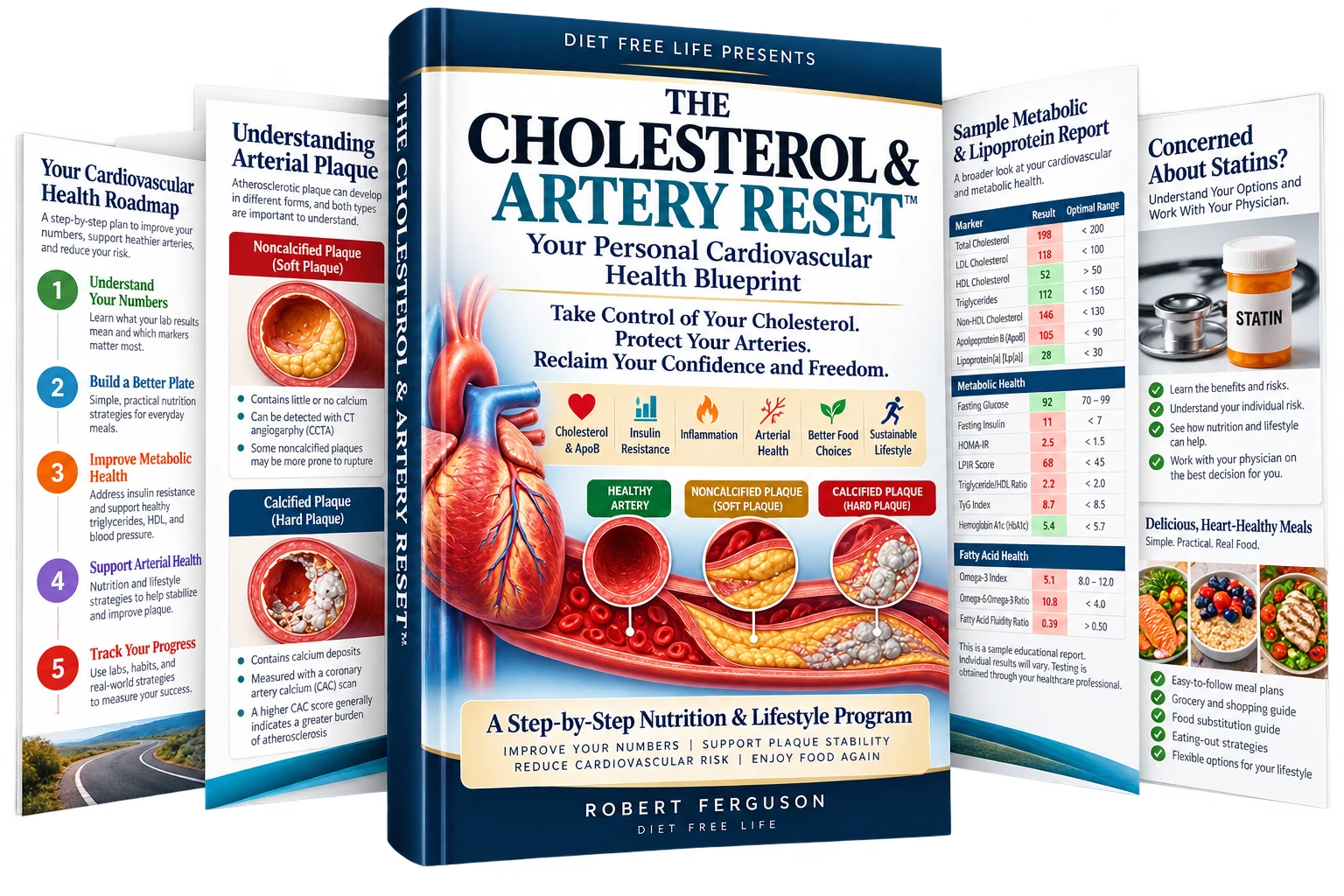
Calcified plaque contains deposits of calcium.
A coronary artery calcium (CAC) scan measures calcified plaque and provides a score that helps physicians assess cardiovascular risk.
Generally, a higher CAC score indicates a greater burden of coronary atherosclerosis and a higher risk of future cardiovascular events.
Noncalcified plaque contains little or no detectable calcium.
Some noncalcified plaques have characteristics associated with increased vulnerability.
A coronary CT angiography (CCTA) scan can identify both calcified and noncalcified plaque and assess whether plaque is narrowing the coronary arteries.
Here's why this matters:
You can have cholesterol numbers that don't appear especially concerning and still have coronary artery disease.
And a CAC score of zero does not necessarily mean you have no noncalcified plaque.
If you're concerned about your cholesterol or cardiovascular risk, I encourage you to speak with your physician about whether a CAC scan would be appropriate.
If you're experiencing symptoms that may indicate coronary artery disease, your physician may recommend further evaluation, potentially including CCTA.
These tests are not necessary for everyone. Their value depends on your age, symptoms, medical history, and overall cardiovascular risk.
The goal is to understand your risk so you can make informed decisions about protecting your heart.
When people think about heart disease, they often focus almost exclusively on cholesterol.
But cardiovascular disease is more complicated than that.
Two important contributors are insulin resistance and chronic inflammation.
Insulin resistance develops when cells become less responsive to insulin.
Your pancreas may compensate by producing additional insulin to help regulate blood sugar.
Over time, insulin resistance is associated with several cardiovascular risk factors, including:
Elevated triglycerides
Lower HDL cholesterol
Unfavorable lipoprotein particle patterns
High blood pressure
Increased abdominal fat
Endothelial dysfunction
Increased cardiovascular risk
And here's something many people don't realize:
You can have normal fasting blood sugar while already experiencing insulin resistance.
That's why focusing exclusively on glucose or LDL cholesterol can leave important questions unanswered.
Inflammation is another important part of atherosclerosis.
When apolipoprotein B (ApoB)-containing lipoprotein particles become retained inside the artery wall, they can trigger inflammatory responses.
Immune cells enter the affected area and contribute to plaque development.
Over time, ongoing inflammation can influence plaque growth, composition, and stability.
That's why The Cholesterol & Artery Reset™ addresses nutrition and lifestyle factors associated with metabolic dysfunction and chronic inflammation.
The endothelium is the thin layer of cells lining your blood vessels.
Covering these cells is a delicate protective layer called the endothelial glycocalyx.
Together, they play important roles in vascular function, blood flow regulation, and interactions between circulating substances and the vessel wall.
Insulin resistance, oxidative stress, and inflammation can impair endothelial function and affect the glycocalyx.
Our goal is to support a healthier vascular environment—not simply make a cholesterol number look better.
Atherosclerosis develops over time through interactions involving ApoB-containing lipoproteins, metabolic health, inflammation, and the artery wall.
Research shows that effective cardiovascular risk-factor management can help stabilize plaque, slow its progression, and, in some circumstances, contribute to regression of certain plaque components.
That's one of the reasons I created The Cholesterol & Artery Reset™.
The nutrition plan is designed to help improve the conditions that contribute to atherosclerosis.
Our approach focuses on:
Improving cholesterol and triglyceride levels
Supporting healthier ApoB-containing lipoprotein levels
Improving insulin sensitivity
Supporting healthy blood pressure
Improving body composition when appropriate
Increasing dietary fiber
Choosing healthier fats
Supporting endothelial function
Reducing modifiable cardiovascular risk factors
Not all plaque behaves the same way.
Noncalcified plaque may decrease with effective treatment in some individuals.
Calcified plaque, however, may persist or become more densely calcified as plaque stabilizes.
That's why our objective isn't simply to make calcium disappear.
It's to help you improve the risk factors that contribute to plaque progression, support plaque stability, and reduce your overall cardiovascular risk.
Nutrition and lifestyle are important parts of that process, alongside appropriate medical care.
This is one of the biggest concerns I hear from people.
Maybe your doctor has recommended a statin, but you'd prefer to explore what you can accomplish through nutrition and lifestyle.
Or perhaps you've been taking a statin for years and would like to know whether improving your metabolic and cardiovascular health could allow your physician to reconsider your treatment.
I understand why that matters to you.
My goal is to help you improve the factors within your control so you can have a more informed conversation with your physician.
We'll focus on a structured nutrition and lifestyle plan designed to improve cholesterol and other modifiable cardiovascular risk factors.
Your physician can then assess your overall risk and determine whether medication remains appropriate.
We'll work toward improving your nutrition, metabolic health, and cardiovascular risk factors while you continue following your physician's treatment recommendations.
As your health markers change, you and your physician can review whether any medication adjustments are medically appropriate.
Some people may be able to manage their risk without a statin, while others—particularly those with established cardiovascular disease or very high risk—may benefit substantially from continued medication.
I won't promise that everyone can avoid or discontinue a statin.
What I will promise is to help you understand your numbers, follow a practical plan, and become a more informed participant in decisions about your health.
Your medication decisions should always be made together with your prescribing physician.
One of the foundations of The Cholesterol & Artery Reset™ is understanding the bigger picture.
Depending on your medical history, available results, and the testing recommended by your healthcare professional, the following measurements can provide valuable information.
Metabolic Flexibility Score (MF Score): A screening tool for identifying potential metabolic warning signs.
Fasting Insulin: Helps evaluate circulating insulin levels.
Fasting Glucose: Measures blood sugar after fasting.
Hemoglobin A1c (HbA1c): Reflects average blood glucose over approximately two to three months.
HOMA-IR: An estimate of insulin resistance calculated using fasting insulin and fasting glucose.
Lipoprotein Insulin Resistance (LPIR) Score: Uses nuclear magnetic resonance (NMR) lipoprotein measurements to identify patterns associated with insulin resistance.
Triglyceride-to-HDL Cholesterol Ratio: A practical metabolic risk indicator.
Triglyceride-Glucose (TyG) Index: An estimate of insulin resistance based on fasting triglycerides and glucose.
Total cholesterol
LDL cholesterol (LDL-C)
HDL cholesterol (HDL-C)
Triglycerides
Non-HDL cholesterol
Estimated remnant cholesterol
Apolipoprotein B (ApoB)
Lipoprotein(a), or Lp(a)
Omega-6 Ratio
Omega-3 Index
Eicosapentaenoic acid (EPA)
Docosahexaenoic acid (DHA)
Fatty Acid Fluidity Ratio
These measurements can help provide a broader picture of metabolic and cardiovascular health.
Specialized testing is not required for every participant and may involve separate laboratory costs.
The purpose isn't to overwhelm you with numbers. It's to help you understand which measurements matter and what you can do about them.
I don't believe improving cholesterol requires spending the rest of your life eating food you don't enjoy.
And I don't believe in handing you a giant list of forbidden foods.
Instead, I'll help you understand how to build meals that support your goals.
You'll learn how to combine foods, choose healthier fats, increase fiber, and make practical changes without feeling deprived.
No extreme dieting.
No unnecessary restrictions.
No complicated food rules.
Just a structured plan designed to fit into your real life.
Because the best nutrition plan isn't the one you can tolerate for seven days.
It's the one you can continue following.
The Cholesterol & Artery Reset™ teaches you how to make practical changes that support cardiovascular and metabolic health.
You'll learn:
What foods to eat more often.
What foods you may benefit from eating less often.
How to choose fats that support cardiovascular health.
How to increase fiber-rich foods.
How to build balanced, cholesterol-friendly meals.
How carbohydrates, insulin, and triglycerides are connected.
How to make practical food substitutions.
How to shop for foods that support your goals.
How to make better choices when eating out.
How physical activity supports insulin sensitivity.
How sleep and daily habits influence metabolic health.
How to track progress without becoming obsessed with every number.
Most importantly:
When you join The Cholesterol & Artery Reset™, you'll receive the following program resources.
A practical eating strategy designed to help improve cholesterol, support insulin sensitivity, and address modifiable cardiovascular risk factors.
Learn how to build meals for breakfast, lunch, dinner, and appropriate snacks without making food complicated.
Walk into the grocery store knowing what to look for, what to buy, and how to read food labels.
Discover simple food substitutions that improve nutritional quality without requiring you to completely change how you eat.
Learn practical ways to make healthier choices at restaurants, while traveling, and during social occasions.
Understand how exercise, everyday movement, sleep, and weight management can support your metabolic and cardiovascular health.
Learn about cholesterol, ApoB, insulin resistance, inflammation, endothelial function, and arterial plaque in language you can understand.
Track your habits, monitor your progress, and use follow-up laboratory results obtained through your healthcare professional to evaluate changes over time.
Think about how you felt the last time your cholesterol results came back.
Maybe you were concerned.
Maybe you were frustrated.
Maybe you wondered what you had done wrong.
Now imagine approaching your next test differently.
You've been following a practical nutrition plan.
You've learned how to make better food choices.
You've become more active.
You've been working on your metabolic health.
You've developed habits that support your cardiovascular goals.
And now, instead of simply hoping your numbers improve, you know you've been taking meaningful action.
That's the confidence I want you to experience.
Results vary, but the goal is to give you a clear process for making changes and evaluating your progress.
Imagine sitting down to breakfast without wondering whether you're making the wrong choice.
Imagine going to a restaurant and knowing how to order a meal that supports your goals.
Imagine shopping for groceries without feeling overwhelmed by conflicting nutrition advice.
Imagine walking into your doctor's office with a better understanding of your cholesterol, insulin resistance, and cardiovascular risk factors.
And imagine knowing that you're actively participating in decisions about your health.
Freedom from unnecessary food restrictions.
Freedom from constantly guessing what to eat.
Freedom from feeling overwhelmed by conflicting advice.
And greater confidence in your ability to make informed health decisions.
This is about more than cholesterol. It's about improving your relationship with food and taking a more confident approach to your long-term health.
This program was created for people who:
Have been told their cholesterol is high.
Have elevated LDL cholesterol or triglycerides.
Are concerned about insulin resistance.
Have been diagnosed with prediabetes.
Have an elevated coronary artery calcium score.
Have known coronary artery plaque and want to improve modifiable risk factors alongside medical treatment.
Want to understand ApoB, Lp(a), and other cardiovascular markers.
Want to explore whether lifestyle changes could help them avoid starting a statin.
Are taking a statin and want to work with their physician to evaluate their long-term treatment options.
Are tired of conflicting nutrition advice.
Want a practical eating plan without extreme dieting.
Want to feel more informed and confident about their cardiovascular health.
Most importantly, this program is for people who are ready to take meaningful action.
There are plenty of cholesterol diets online.
You can download another food list.
You can watch another video.
You can read another article.
But information alone doesn't always lead to change.
Knowing you should eat better and knowing how to eat better every day are two different things.
That's the gap The Cholesterol & Artery Reset™ is designed to close.
We're not simply looking at cholesterol.
We're helping you understand how several important factors interact:
Cholesterol and ApoB-containing lipoproteins.
Insulin resistance and metabolic flexibility.
Chronic inflammation.
The endothelium and endothelial glycocalyx.
Cellular fatty acid health.
The nutrition and lifestyle choices you make every day.
The result is a broader approach to cardiovascular health that goes beyond conventional cholesterol-focused diet advice.
One of the easiest things to do is wait.
You get a warning about your cholesterol.
You promise yourself you're going to start eating better.
A few months go by.
Then another year.
And when your next blood test comes back, you're having the same conversation.
But you don't have to keep repeating that cycle.
You can start making meaningful changes now.
Not because you need to be afraid.
But because you deserve to feel informed, prepared, and confident about your health.
For more than 30 years, I've helped people understand nutrition and make meaningful lifestyle changes.
One thing I've learned is that people don't simply want better laboratory numbers.
They want peace of mind.
They want to know what they should be eating.
They want to stop feeling confused.
They want to feel confident when they meet with their doctors.
And many want to know whether they can improve their health without adding another medication—or whether a medication they're already taking is still necessary.
That's why I created The Cholesterol & Artery Reset™.
I want to help you take control of what you can change.
I want you to understand your cholesterol numbers, insulin resistance, inflammation, and cardiovascular risk factors.
I want you to have a nutrition plan that makes sense and that you can actually follow.
And I want you to experience the confidence and freedom that come from understanding what you're doing and why.
My commitment is to provide practical guidance and help you build healthier habits while encouraging you to work with your physician on medical testing and treatment decisions.
Because you deserve more than another warning about your cholesterol. You deserve a plan.
— Robert Ferguson
You don't need another restrictive diet.
You don't need another confusing list of foods to avoid.
And you don't need to keep wondering whether you're doing enough to protect your cardiovascular health.
You need a clear strategy.
A practical nutrition plan.
A better understanding of your numbers.
And a way to measure your progress.
Improve Your Cholesterol. Address Insulin Resistance and Inflammation. Support Healthier Arteries.
Take the Next Step Toward Better Cardiovascular Health.
Medical information: This program provides nutrition, lifestyle, and educational guidance. It does not guarantee cholesterol reduction, plaque regression, calcium-score reduction, medication discontinuation, or prevention of cardiovascular events. Imaging and laboratory testing should be determined with your healthcare professional. Do not stop or change prescribed medication without consulting your prescribing clinician. If you experience severe or persistent chest pain or other possible heart attack symptoms, seek emergency medical attention.


