Sale
At-Home Cellular Health Test
$149.95
$85.00
(No reviews yet)

Write a Review
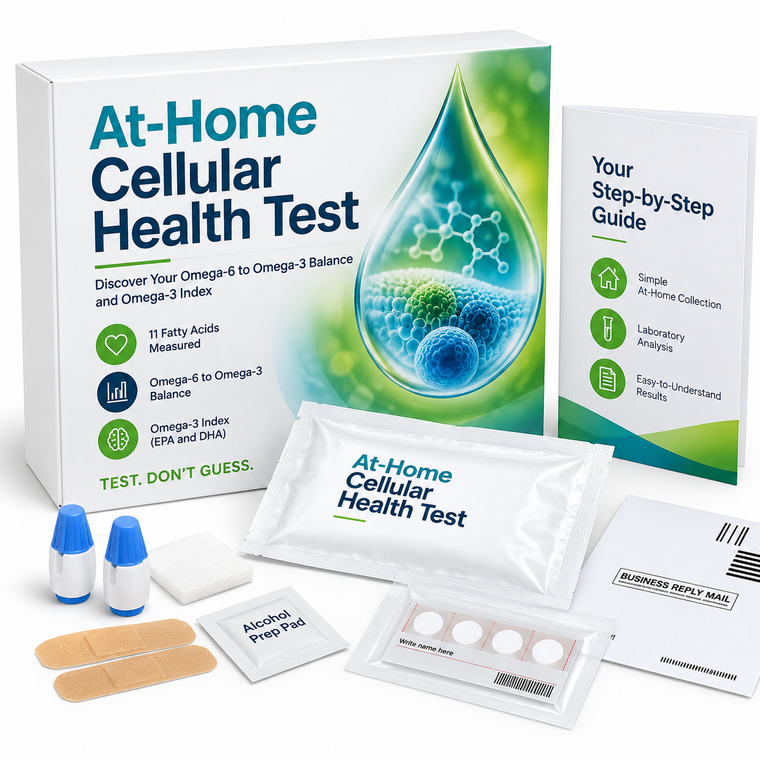
At-Home Cellular Health Test
At-Home Cellular Health Test
What If One of Your Biggest Health Blind Spots Is Happening Inside Your Cells?
Discover your omega-6 to omega-3 balance, learn about the fatty acids that influence cell membrane properties, and take a more informed approach to your long-term health.
You may eat healthy, exercise regularly, take supplements, and have normal blood work.
But here's something most people have never considered.
What's happening at the level of your cell membranes?
Your body contains trillions of cells. Every one of them depends on a membrane that helps regulate communication, nutrient transport, and responses to biological signals.
And the types of fatty acids associated with those membranes matter.
Research has linked fatty acid status with cardiovascular health, cognitive decline, and mortality. Scientists are also investigating how omega-6 and omega-3 fatty acids participate in biological pathways relevant to inflammation and cancer.
Yet most people have never measured their fatty acid status.
The At-Home Cellular Health Test helps change that.
With a simple fingertip blood sample, you can discover your omega-6 to omega-3 balance, Omega-3 Index, and other important fatty acid measurements.
TEST. DON'T GUESS.
Why Your Cell Membranes Matter More Than You May Realize
Think of your cell membrane as a sophisticated communication center.
It isn't simply a protective wall surrounding your cells.
Your cell membranes help regulate:
✅ How cells receive and respond to biological signals
✅ How nutrients and other substances move across membranes
✅ How certain hormones interact with cellular signaling systems
✅ How immune cells communicate and respond
✅ How fatty acids contribute to inflammatory and resolution pathways
What Is Cell Membrane Fluidity?
Cell membranes aren't rigid structures. They're dynamic, constantly moving assemblies of fats and proteins.
Cell membrane fluidity describes how freely certain molecules move within the membrane.
This property can influence the organization and activity of membrane proteins involved in communication and transport.
Omega-3 fatty acids, particularly docosahexaenoic acid (DHA), contribute to the physical properties of membranes.
DHA is especially important in tissues such as the brain and retina, where it contributes to normal membrane structure.
But there's an important distinction.
The goal isn't to make cell membranes as fluid as possible. It's to support normal membrane structure and function.
Different cells require different membrane characteristics.
What Does the Test Reveal About Membrane Fluidity?
The At-Home Cellular Health Test provides a calculated Cell Membrane Fluidity Indicator, based on selected fatty acid measurements.
This gives you insight into an aspect of fatty acid composition associated with membrane properties.
It does not directly measure the physical fluidity of your cells or determine whether your membranes are functioning properly.
Nevertheless, understanding your fatty acid composition can provide a useful starting point for improving your nutritional habits.
Your Omega-6 to Omega-3 Balance: Why This Number Deserves Your Attention
Omega-6 and omega-3 fatty acids are important components of human nutrition.
Both families participate in cell membrane structure and biological signaling.
Your body needs both.
However, they have different roles in certain pathways involved in inflammatory signaling and its resolution.
For example:
Omega-6 arachidonic acid (AA) contributes to the production of signaling molecules involved in immune responses, inflammation, and blood clotting.
Omega-3 eicosapentaenoic acid (EPA) and DHA contribute to membrane structure and serve as precursors for signaling molecules involved in regulating and resolving inflammation.
Neither family is inherently good or bad.
The important question is whether your overall fatty acid status supports your nutritional goals.
What Does Your Ratio Tell You?
The test's headline Omega-6 to Omega-3 Balance Value compares AA with EPA.
In our nutrition practice, we use a preferred AA/EPA ratio of 3:1 or lower.
Some people we've tested have reported ratios far above that target, including results of 40:1, 50:1, and even higher.
These are individual practice observations, not representative population statistics.
Wouldn't you rather know your number than assume everything is fine?
Your ratio doesn't diagnose inflammation or predict disease.
But it provides measurable information about two fatty acids involved in important biological processes.
And unlike many health characteristics, fatty acid status can change with nutrition.
What Does Scientific Research Reveal About Fatty Acid Balance and Disease?
This is where the conversation becomes especially important.
Researchers have been studying omega-6 and omega-3 fatty acids for decades.
Their findings suggest that fatty acid status deserves attention as one part of a comprehensive approach to long-term health.
Alzheimer's Disease and Cognitive Decline
A 2026 study published in Alzheimer's & Dementia examined fatty acid profiles and cognitive outcomes in two research populations involving more than 5,000 participants.
Researchers found that higher omega-6 to omega-3 polyunsaturated fatty acid ratios were associated with less favorable cognitive outcomes, including greater progression toward dementia.
Changes toward lower ratios were associated with slower cognitive decline.
Why is this important?
Because Alzheimer's disease develops over many years, and scientists are investigating potentially modifiable nutritional factors associated with brain aging.
The study does not prove that lowering your ratio prevents Alzheimer's disease, and its measurements are not identical to the AA/EPA calculation used by this test.
But it provides an important reason to take fatty acid research seriously.
Research: Andrade et al., 2026, Alzheimer's & Dementia.
Cardiovascular Disease and Longevity
Large observational studies have found that people with higher blood levels of EPA and DHA often experience lower rates of cardiovascular events or mortality.
In the Framingham Offspring Cohort, researchers found that differences in red blood cell omega-3 status corresponded to approximately five years of difference in modeled age-related mortality risk.
That's a meaningful association worth understanding.
It doesn't mean improving your Omega-3 Index automatically adds five years to your life.
But it demonstrates why fatty acid status continues to be studied as a potential indicator of long-term health.
Research: Harris et al., 2018; McBurney et al., 2021.
Cancer and Cellular Health
Cancer involves changes in cellular growth, signaling, metabolism, and immune interactions.
Because omega-6 and omega-3 fatty acids participate in membrane structure and inflammatory pathways, researchers have investigated their possible relationships with cancer biology.
However, clinical trials have not established that increasing omega-3 intake or lowering an AA/EPA ratio reliably prevents cancer.
A large systematic review of randomized trials found little or no overall reduction in cancer incidence from increasing long-chain omega-3 intake.
The important takeaway is that fatty acids participate in biological processes relevant to cellular health—not that a particular ratio is a proven cancer-prevention strategy.
Research: Hanson et al., 2020, British Journal of Cancer.
Inflammation and Immune Function
Your body needs inflammation to respond to infections and injuries.
But inflammation must also be appropriately regulated and resolved.
Omega-6 and omega-3 fatty acids are involved in producing different lipid-derived signaling molecules that participate in these processes.
EPA and DHA can serve as precursors for specialized pro-resolving mediators, including resolvins and protectins.
Understanding your fatty acid status provides nutritional context, although it does not directly measure inflammation.
Research: Calder, 2015; Serhan, 2014.
What Exactly Will Your Test Tell You?
Your At-Home Cellular Health Test measures 11 fatty acids in whole blood and provides six calculated indicators.
Your Results Include:
✅ 1. Omega-6 to Omega-3 Balance
Discover your AA/EPA ratio and compare it with your preferred nutritional target.
✅ 2. Omega-3 Index
Learn about your EPA and DHA status—two fatty acids important for normal cell membrane structure and function.
✅ 3. Cell Membrane Fluidity Indicator
Receive a calculated indicator based on selected fatty acids associated with membrane properties.
✅ 4. Mental Strength Indicator
Review a fatty acid calculation comparing AA with EPA and DHA. This is not a direct measure of memory or cognitive performance.
✅ 5. Arachidonic Acid Index
Learn about your AA status, an omega-6 fatty acid involved in cellular signaling.
✅ 6. Overall Fatty Acid Score
Receive a combined score based on selected measurements in your fatty acid profile.
Together, these results provide a more detailed picture of your fatty acid status than simply knowing whether you take omega-3 supplements.
What Happens After You Take the Test?
This is where the real value begins.
Step 1: Discover Your Starting Point
Your results show your current fatty acid measurements.
You'll see whether your reported AA/EPA ratio and Omega-3 Index fall within the test's reference ranges.
Step 2: Understand What Your Numbers Mean
Review your results and learn how omega-6 and omega-3 fatty acids relate to membrane structure, cellular signaling, and nutritional health.
The report provides reference information to help explain the measurements.
Step 3: Make Informed Nutritional Changes
Depending on your results, you may consider:
✅ Eating more EPA- and DHA-rich fatty fish
✅ Reviewing the actual EPA and DHA amounts in your supplements
✅ Improving overall dietary quality
✅ Considering an appropriate omega-3 supplement
✅ Following a consistent nutrition strategy
The objective is not simply to take more supplements.
It's to make informed choices based on your actual measurements.
Step 4: Retest After Approximately 120 Days
After making nutritional changes, consider repeating the test.
Then compare your results.
Did your AA/EPA ratio improve?
Did your Omega-3 Index increase?
Did your calculated membrane fluidity indicator change?
You'll have objective information about changes in your fatty acid profile.
The test cannot determine whether those changes reduced your risk of a particular disease, but it can show whether your nutritional strategy is affecting the measurements you're tracking.
Already Taking Fish Oil? Here's Why You May Still Want to Test.
Many people assume that taking fish oil means they have excellent omega-3 status.
But that's not necessarily true.
A capsule labeled 1,000 milligrams (mg) of fish oil may contain substantially less than 1,000 mg of EPA and DHA.
And individuals can respond differently to the same supplement.
After reviewing thousands of fatty acid test results, we've seen many people taking omega-3 products who had not reached the nutritional targets we use in our practice.
Taking a supplement is an action. Knowing your fatty acid status is information.
And that's the difference.
TEST. DON'T GUESS.
Who Should Consider the At-Home Cellular Health Test?
This test may be particularly useful for people who:
✅ Want to better understand their cellular nutrition
✅ Are interested in cell membrane structure and fatty acid balance
✅ Take omega-3 supplements but have never measured their status
✅ Rarely eat fatty fish
✅ Are interested in research on brain health and healthy aging
✅ Want to establish a baseline and monitor nutritional changes
✅ Feel healthy but want to learn more about what routine blood work doesn't measure
You don't need to be sick to be interested in nutritional health.
Your cells matter whether you're 25 or 75.
How Easy Is It to Take the Test?
1. ORDER: Receive your test kit at home.
2. COLLECT: Use the included supplies to collect a few drops of blood from your fingertip.
3. MAIL: Send your sample to the laboratory using the supplied instructions.
4. REVIEW: Access your confidential fatty acid report online.
5. TAKE ACTION: Use the results to make informed nutritional decisions.
6. RETEST: Consider repeating the test after approximately four months to monitor your progress.
No routine laboratory appointment is required for sample collection.
Frequently Asked Questions
Does improving my omega-6 to omega-3 ratio reduce my risk of Alzheimer's disease?
Research has found associations between certain omega-6 to omega-3 fatty acid ratios and cognitive outcomes. However, it has not established that improving the AA/EPA ratio measured by this test prevents Alzheimer's disease or reduces an individual's dementia risk.
Can improving my ratio prevent cancer?
There is no reliable clinical evidence that reaching a particular AA/EPA ratio prevents cancer. The test can help assess fatty acid status, but it is not a cancer screening or prevention test.
Does the test measure cell membrane fluidity?
It reports a calculated indicator associated with fatty acid composition. It does not directly measure membrane fluidity in your body's cells.
What if my results are outside the target range?
You can review your diet, omega-3 intake, and other nutritional habits, then consider retesting to see whether your fatty acid measurements change.
What if my results are already good?
You'll have a useful baseline for future comparisons and additional information about your current nutritional status.
Do I have to buy supplements after taking the test?
No. Testing doesn't obligate you to purchase supplements. Dietary changes, supplements, or a combination of approaches may be considered based on your individual circumstances.
Your Cells Deserve More Than Guesswork
Every second, your cells are communicating, responding, transporting nutrients, and carrying out the functions that keep you alive.
Fatty acids are an important part of the membranes that make those processes possible.
Yet most people have never measured their omega-6 to omega-3 balance or Omega-3 Index.
Why continue guessing?
Discover your fatty acid status.
Understand your numbers.
Make informed nutritional changes.
And measure your progress.
TEST. DON'T GUESS.
ORDER YOUR AT-HOME CELLULAR HEALTH TEST TODAY
Related Products
-
-
-
Sale